The Union Cabinet has approved a series of major decisions aimed at boosting industrial growth, farmer welfare, and clean energy development in India.
Briefing the media, Union Minister Ashwini Vaishnaw said the initiatives will strengthen manufacturing, support farmers, and accelerate sustainable energy expansion.
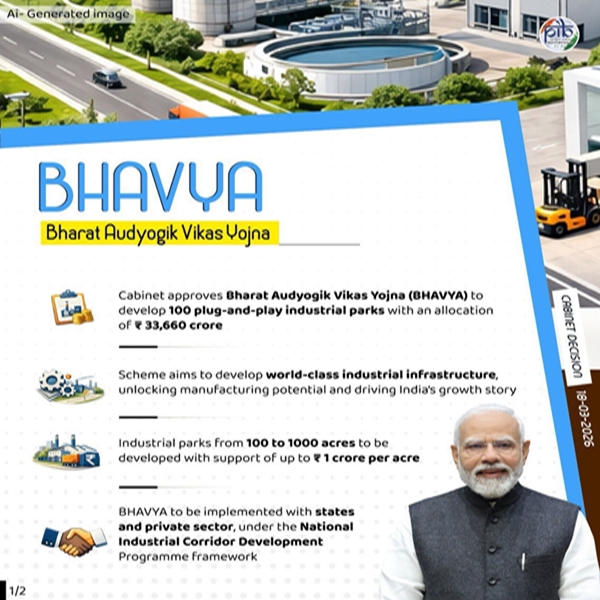
BHAVYA Scheme to Develop 100 Industrial Parks
The Cabinet approved the Bharat Audyogik Vikas Yojana (BHAVYA) with an outlay of ₹33,660 crore.
Key highlights:
-
Development of 100 plug-and-play industrial parks
-
Parks to be spread across 100 to 1,000 acres
-
Financial support of up to ₹1 crore per acre
The scheme aims to:
-
Create world-class industrial infrastructure
-
Unlock manufacturing potential
-
Boost economic growth and job creation
₹1,718 Crore MSP Support for Cotton Farmers
In a major relief for farmers, the Cabinet approved over ₹1,718 crore as MSP funding to the Cotton Corporation of India (CCI) for the 2023–24 cotton season.
The funding will:
-
Provide direct price support to cotton farmers
-
Protect farmers when market prices fall below MSP
-
Ensure stable income for growers
The move aligns with the government’s focus on farmer welfare and income security.
Small Hydro Power Scheme Approved
The Cabinet also approved the Small Hydro Power Development Scheme for the period 2026–27 to 2030–31 with an outlay of ₹2,584 crore.
Key features:
-
Development of Small Hydro Power (SHP) projects
-
Target capacity of 1,500 MW
-
Incentives for states to prepare Detailed Project Reports (DPRs) for around 200 projects
The scheme is expected to strengthen India’s renewable energy capacity.
Push for Aatmanirbhar Bharat and Sustainable Growth
These decisions reflect the government’s focus on:
-
Promoting industrialisation
-
Supporting farmers through MSP operations
-
Expanding clean energy infrastructure
The initiatives are aligned with the vision of Aatmanirbhar Bharat, aiming to make India a self-reliant and globally competitive economy.
Driving Multi-Sector Growth
The combined impact of these approvals is expected to:
-
Boost manufacturing and infrastructure
-
Enhance farmer incomes
-
Generate employment
-
Promote sustainable development